
Both cordierite and glass-ceramics, with their core advantages of low thermal expansion and high temperature resistance, are commonly used in high-end functional fields. However, they exhibit fundamental differences in essence, manufacturing process, performance, and application, and are not variants of the same material. Clarifying the distinctions between the two can better accommodate different working conditions and avoid selection biases.
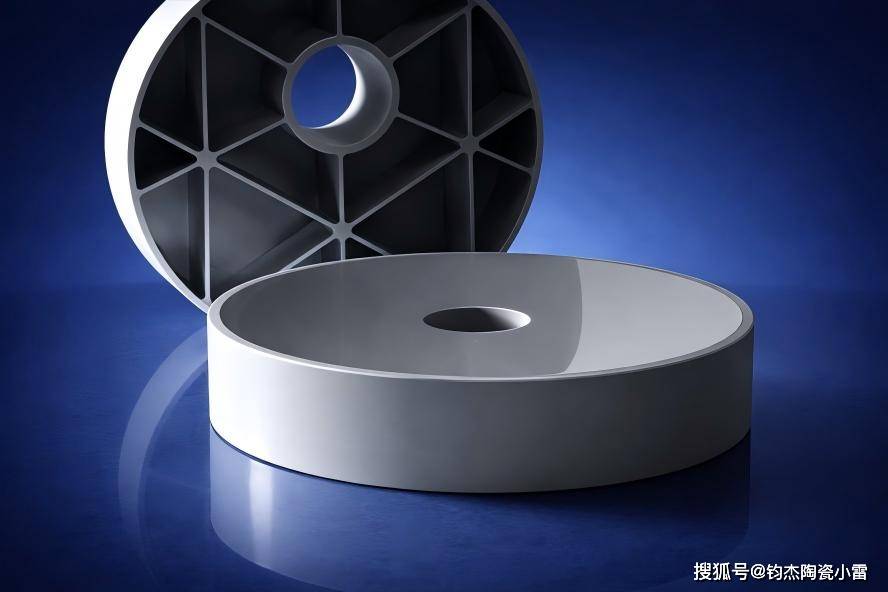
In terms of essence and composition, the two belong to distinct categories. Cordierite is a polycrystalline ceramic of magnesium aluminosilicate minerals, with an ideal chemical formula of $\ce{Mg2Al4Si5O18}$. It is primarily produced through sintering high-purity powder in industry, with the main crystalline phase being stable α-cordierite, no residual glass phase, fixed composition ratio, and no nucleating agents or fluxing agents. On the other hand, glass-ceramics are glass-based polycrystalline composite materials formed through controlled heat treatment of base glass, constituting a two-phase system of "amorphous glass phase + polycrystalline phase". They exhibit flexible composition and require the addition of nucleating agents such as TiO₂ and ZrO₂ to induce crystallization, with a small amount of glass phase always remaining.
The differences in preparation processes determine the structural foundations of the two materials. Cordierite adopts a ceramic sintering route. After mixing and molding high-purity raw material powders, it undergoes high-temperature solid-phase sintering at 1350~1450℃, directly achieving crystal growth and densification without glass melting and crystallization steps, ultimately forming a fully crystalline and dense structure. Microcrystalline glass follows the glass crystallization route. First, raw materials are melted into glass liquid, molded, and cooled. Then, it undergoes two-step heat treatment: low-temperature nucleation and high-temperature crystallization, allowing crystals to precipitate in situ from the glass matrix. The core principle is "first form glass, then turn into crystals".

The differences in microstructure and core properties further distinguish the application boundaries of the two. Cordierite has a fully crystalline single-phase structure with uniform grains and high density. Its thermal conductivity is 3 to 4 times that of glass-ceramics, and it exhibits superior thermal shock resistance, mechanical strength, and chemical stability, capable of withstanding strong acids, alkalis, and high-temperature corrosion. On the other hand, glass-ceramics have a microcrystalline phase dispersed in a glass matrix. Although they also possess near-zero expansion characteristics, their thermal conductivity, stiffness, and thermal shock resistance are weaker. However, they can achieve transparency or translucency, combining the optical uniformity of glass, making them suitable for optical applications.
The differences in application scenarios directly reflect the characteristics of the two materials. Cordierite is primarily used in high-temperature, high-stability, and highly corrosive environments, and is widely applied in semiconductor etching components, automotive three-way catalyst carriers, industrial kilns, and kiln furniture. On the other hand, glass-ceramics focus on optical properties and applications in daily use and construction, such as astronomical telescope mirrors, induction cooker panels, and precision optical platforms.
In summary, cordierite is a fully crystalline ceramic with high thermal conductivity and high stability as its core advantages; glass-ceramics are crystal-glass composite materials characterized by good optical properties. Although both share the label of low thermal expansion, their technical routes differ. Selection should consider core factors such as operating temperature, corrosivity, and optical requirements, and blind substitution is not advisable.