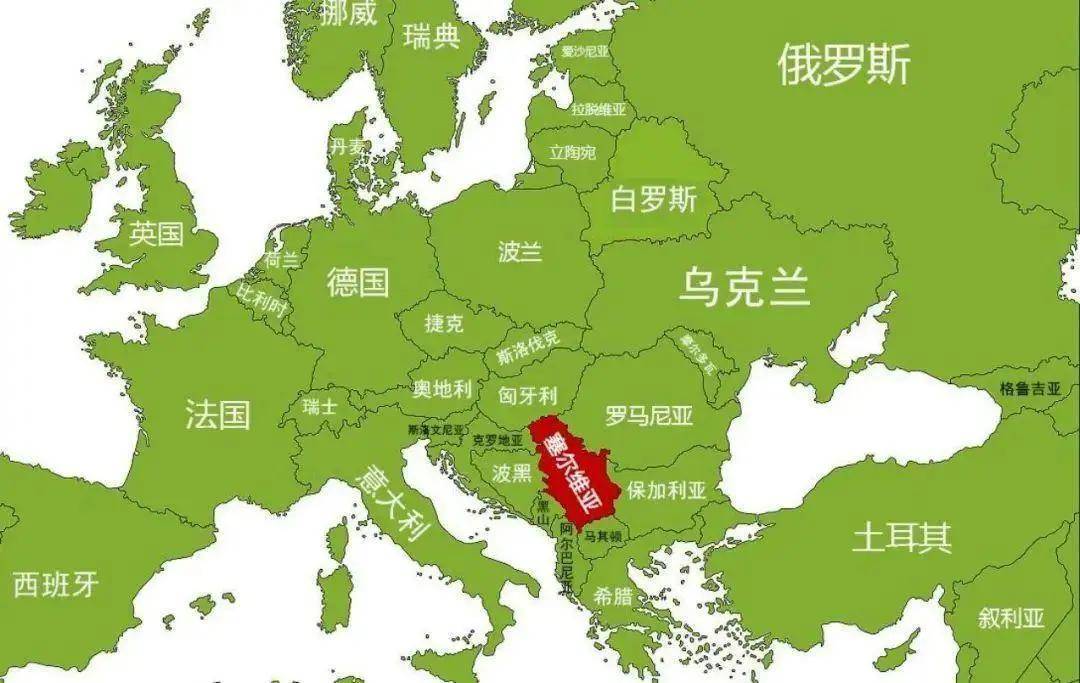
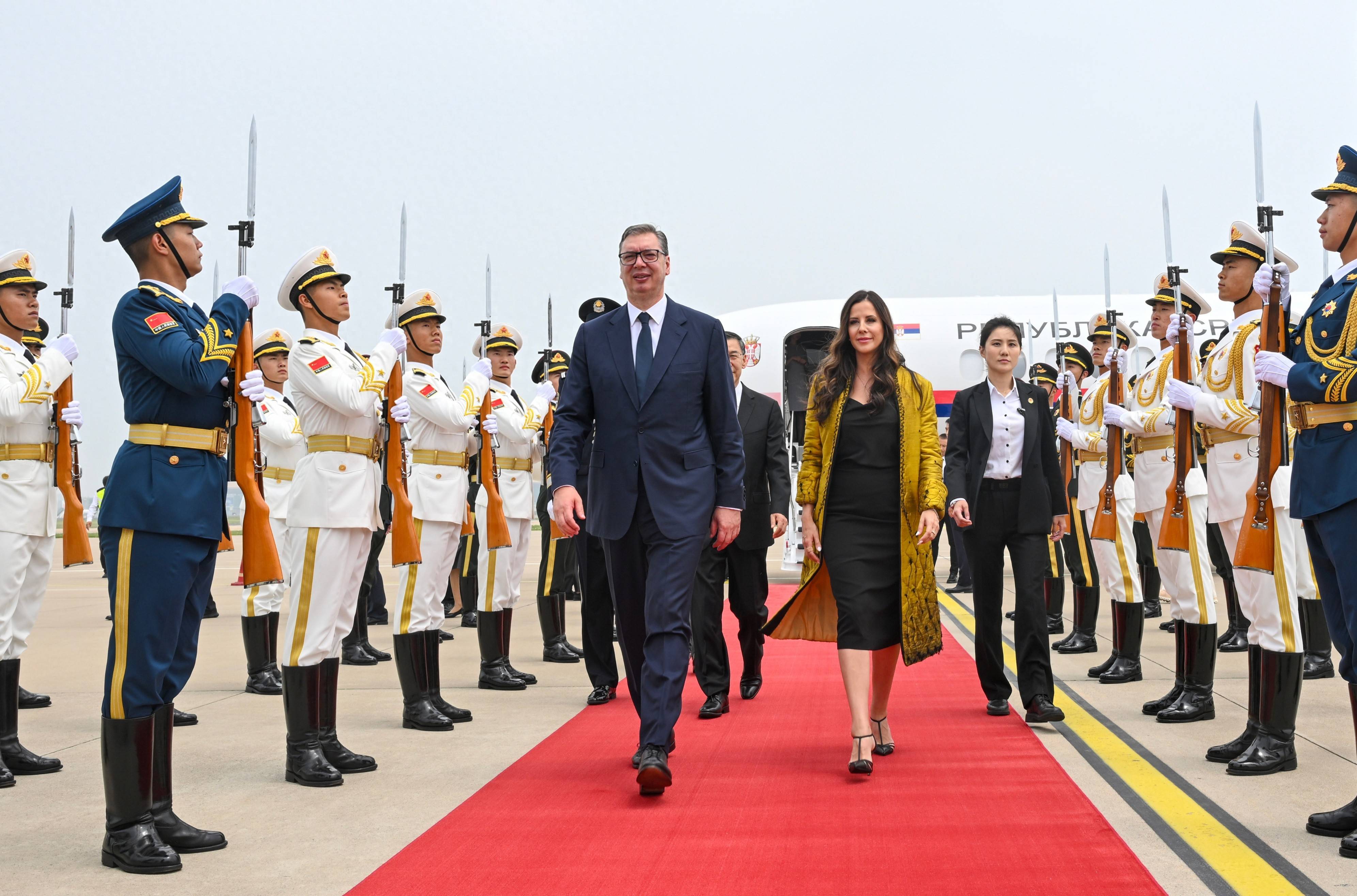
On the afternoon of May 24, Serbian President Aleksandar Vu?i? arrived at Beijing Capital International Airport, embarking on a five-day state visit. On the very same day, Pakistani Prime Minister Shehbaz Sharif began his visit to Hangzhou. With two of China’s key partners arriving almost simultaneously, Tiananmen Square was adorned with the national flags of China, Pakistan, and Serbia. This marks Vu?i?’s first state visit to China as a head of state, a diplomatic engagement of far greater formality than the usual bilateral meetings held during international forums or multilateral summits. Vu?i? himself ribed this trip as the most important visit of my political career. For Serbia, caught under the pressures of NATO and the EU, what issues was sending its president to Beijing meant to address? **Belgrade Confronts Its Dilemmas with Determination** Serbia is geographically surrounded on land by seven NATO members, while NATO forces maintain actual control over the Kosovo region. Earlier this year, Albania, Croatia, and Kosovo signed a defense agreement, further compressing Serbia’s security space with two NATO members and one NATO-protected area. Though not a NATO member itself, Serbia’s airspace, borders, and strategic corridors are effectively under NATO supervision. In such circumstances, Serbia clearly cannot face these sustained pressures alone—it must seek an external power capable of offering political and security support. The EU, meanwhile, has consistently exerted pressure. Serbia has long applied for EU membership, yet Brussels’ conditions remain unchanged: recognition of Kosovo’s independence and compliance with EU sanctions against Russia. Serbia has refused both. As a result, in February of last year, the EU froze €1.6 billion in promised aid loans. German leaders even personally visited Belgrade, offering energy subsidies on the condition that Serbia join sanctions against Russia—but Vu?i? declined. With the EU funding channel closed, Serbia faces slower economic growth and mounting fiscal pressures. Prior to Vu?i?’s departure for China, anonymous EU officials warned that deepening economic and investment cooperation with China could affect Serbia’s accession process—essentially signaling to avoid close ties with powers outside the West. In this context, Serbia’s choice is to turn toward China for political support, economic cooperation, and defense collaboration—a continuation of its long-standing Look East policy. China, a permanent UN Security Council member, respects Serbia’s sovereignty over Kosovo, has signed a free trade agreement with Serbia resulting in nearly 95% of bilateral trade enjoying zero tariffs, and has supplied FK-3 air defense systems and CM-400AKG supersonic air-to-ground missiles to bolster Serbia’s regional defense capabilities. These three areas perfectly align with Serbia’s most pressing needs. Upon arrival in Beijing, Vu?i? appeared relaxed and posted on social media about the warm welcome he received. Such a reception goes beyond mere diplomatic formality; only when a country truly provides the support it requires will a leader, long under external pressure, show genuine relief. Serbia’s choice is not a fleeting diplomatic gamble—it is a calculated decision after weighing all options. The EU’s aid is increasingly conditional, NATO’s security pressure continues, whereas China offers cooperation without internal political strings—a clear alternative for the Serbian government.
**Vu?i?’s Three Objectives** What, specifically, does Vu?i? aim to achieve on this visit? Three priorities stand out. First is securing political support. Serbia’s stance on Kosovo is anchored in UN Security Council Resolution 1244, yet Western powers have steadily undermined this position over the years. The EU ties recognition of Kosovo to accession negotiations, and NATO continues to expand its military presence in Kosovo. Serbia thus needs a partner in the international arena to defend its sovereignty claims. As a permanent UN Security Council member, China can uphold the authority of Resolution 1244 and prevent further erosion against Serbia’s interests. Notably, Serbia is the first European country to jointly build a New Era Community of Shared Destiny with China—a symbolic reflecting deep political trust. China’s support goes beyond rhetoric, encompassing Security Council votes and diplomatic resources in practice. Second is expanding economic cooperation. With EU aid frozen, Serbia needs alternative sources of capital and export markets. The China-Serbia free trade agreement, effective from July 2024, provides a structural framework. Bilateral trade reached $10.6 billion in 2025, roughly 12% of Serbia’s GDP, while Chinese investment in Serbia totals over €7.3 billion, with 37 operational Chinese enterprises. Vu?i? has publicly noted that Serbia’s exports to China increased 330-fold. During this visit, he hopes to sign over 30 cooperation agreements spanning new infrastructure, new energy, the automotive industry chain, batteries, robotics, and information technology. Unlike EU aid, China’s trade and investment come without political conditions, making them highly attractive to the Serbian government.
Third is strengthening defense cooperation. Surrounded by NATO forces, Serbia must enhance its defense capabilities. Over recent years, it has procured China’s FK-3 medium-to-long-range air defense system and CM-400AKG supersonic air-to-ground missiles, making it the only European country west of Belarus to acquire advanced Chinese weaponry. Yet equipment alone is insufficient; technical training, maintenance support, and subsequent upgrades are also required. Vu?i?’s visit likely seeks deeper defense cooperation, including missile launch platforms, longer-range defense systems, and personnel training with technology transfer. China remains the only country capable of providing substantial support across all three areas. These objectives reinforce one another: political support creates space for economic cooperation, economic cooperation funds defense initiatives, and defense ensures political independence. **Lessons for Small Nations** What ripple effects might Vu?i?’s visit produce? The EU has already reacted. Prior to his departure, Brussels warned via anonymous channels that too close ties with China could jeopardize Serbia’s EU accession. Yet the efficacy of such warnings is waning. The core reason is that the EU’s commitments to Serbia have long been deferred promises. Since Belgrade applied for EU membership in 2009 and became a candidate in 2012, accession negotiations have spanned over a decade with limited substantive progress. Conditions regarding Kosovo have remained firm, and demands on Russia sanctions have intensified. Meanwhile, the economic benefits the EU can offer are contracting, with slowed growth, frozen aid, and limited market access. In this environment, urging Serbia to wait has lost persuasive power. Vu?i? called this visit the most important of my political career because it represents a strategic break from a passive stance: Serbia’s diplomatic situation is indeed challenging. Since the Russia-Ukraine conflict, the EU has continuously demanded Serbia take sides, NATO has bolstered military deployments in Eastern Europe, and Vu?i?’s government has struggled to maintain balance under external pressure. Without a strong external partner, Serbia’s diplomatic space would further shrink. Economically, Serbia’s dependence on Europe is high; a downturn or reduced orders would directly impact exports and employment. China’s market of 1.4 billion people and sustained investment capabilities provide an alternative—an institutionalized trade arrangement with continuous capital inflow.
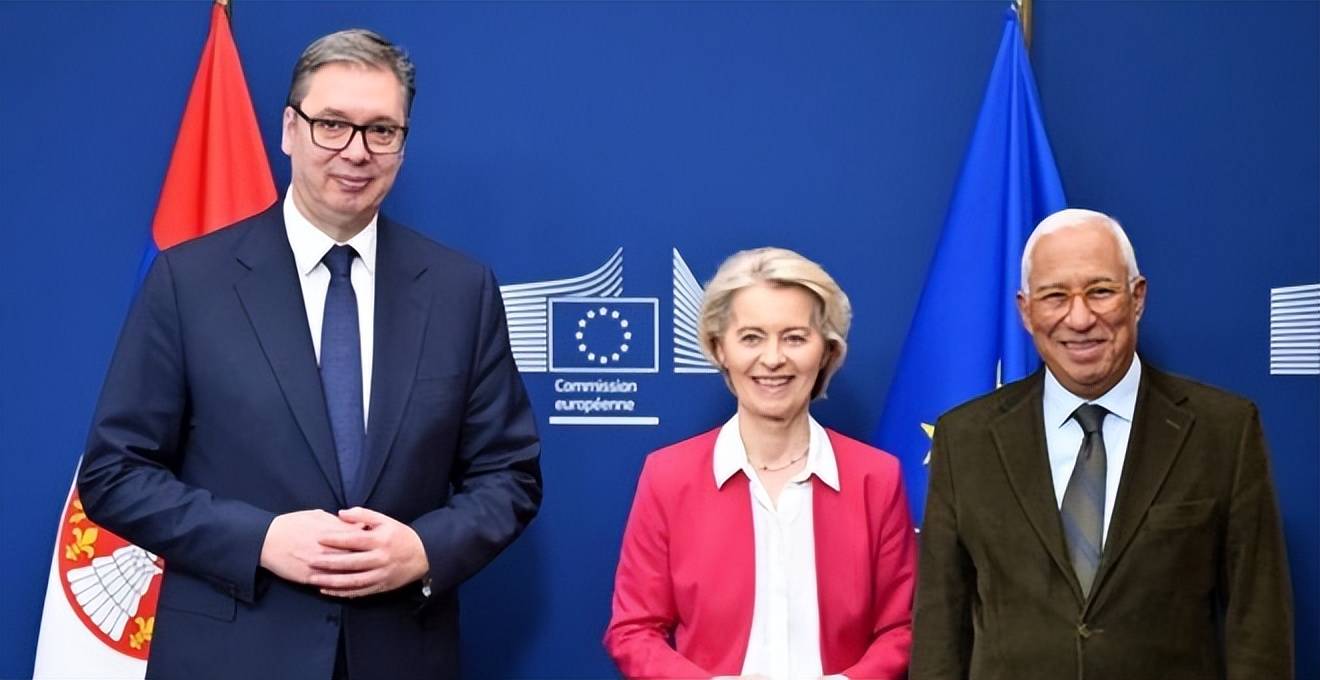
Serbia’s experience offers a contrast. A country of under nine million, geographically encircled by NATO and the EU, manages to maintain an independent foreign policy while securing substantial political, economic, and defense support from China. This demonstrates that small nations need not passively yield to great power pressures. Clear interest assessment and consistent policy execution are key. Since 2013, Serbia’s reindustrialization strategy has progressively opened investment to China, from steel and copper to infrastructure, free trade agreements, and defense cooperation—each step mutually reinforcing the last. Such cumulative effects cannot be easily overturned. Vu?i?’s state visit, including the display of three national flags at Tiananmen Square, ceremonial welcomes, and intensive meetings, is itself a declaration. It signals to other similarly positioned countries that small states can exercise choice. When a nation secures tangible benefits through balanced diplomacy, other nations observing will reassess their foreign policies and no longer consider the West the sole option. This is the demonstrative impact of Serbia’s case. **Foundations of Durable China-Serbia Cooperation** What underpins the current level of China-Serbia relations? Four aspects are critical. First, institutionalized trade arrangements. The China-Serbia FTA has been operating smoothly for over a year, covering nearly 90% of goods, allowing businesses to plan long-term with confidence. Institutional mechanisms provide stability beyond ad hoc agreements, which is vital for a small economy like Serbia’s. The FTA’s effectiveness is evident in 2025 trade surpassing $10 billion.
Second, Chinese enterprises’ deep engagement in Serbia. They are not transient partners signing agreements and leaving, but establish factories, operate continuously, and reinvest. For example, the Smederevo steel plant, acquired by China’s Hesteel Group, shifted from annual losses over €100 million to becoming Serbia’s top export enterprise. Zijin Mining’s acquisition of Bor copper mine transformed it from outdated, loss-making operations into Europe’s second-largest copper-producing region. The Belgrade–Novi Sad segment of the Hungary-Serbia railway cut commuting time from five hours to under one, generating tangible economic impact. Each project involves hundreds of local jobs, technology transfer, and supply chain integration, making these investments stickier than mere trade. Third, mutual support on key issues. On Kosovo, China backs UN Resolution 1244, refusing to recognize Kosovo’s unilateral independence; Serbia, in turn, supports China on core interests. Such reciprocal backing is rooted in years of concrete action.
Fourth, historical emotional ties. In 1999, three Chinese journalists died when China’s embassy in the former Yugoslavia was bombed; Serbians commemorate them annually. This history fosters intangible but strong trust. The Belgrade China Cultural Center, built on the old embassy site, symbolizes this relationship, while China’s engagement has cultivated widespread goodwill among Serbian citizens and elites. Emotional bonds thus translate into political capital for decision-makers. These four pillars collectively define the distinctiveness of China-Serbia relations. Vu?i?’s ription of this visit as the most important of his political career underscores that Serbia is at a critical decision point. A nation of under nine million, under pressure from NATO and the EU, maintains independent diplomacy while securing substantial political, economic, and defense support from China. This outcome reflects years of strategic policy accumulation by the Serbian government and demonstrates how China’s external cooperation model can yield significant results under specific conditions. It also signals to other countries that small states need not passively choose sides in great power competition; through sustained, pragmatic alignment of interests, they can carve out their own space.