
5 Satellites in One Launch, Computing Power in Orbit! Lijian-1 Breaks the 100-Satellite Milestone as Space Computing Networking Enters the "Shuttle Service Era"
From "100-Satellite Launches" to "Space Computing": Commercial Aerospace is Replicating the Growth Logic of AI Computing Power
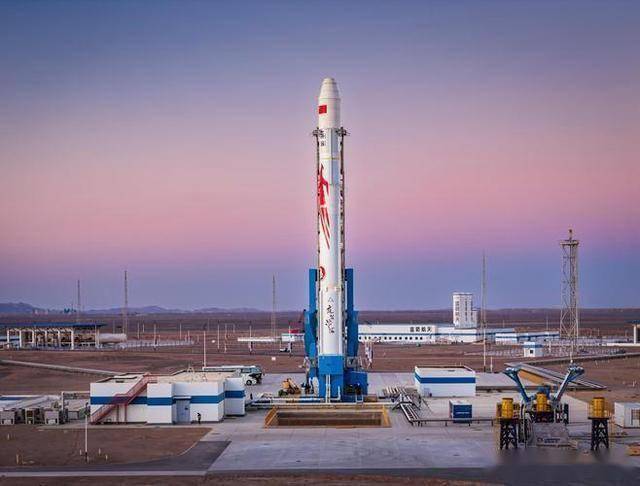
On the morning of July 24, CAS Space's Lijian-1 Y-15 rocket ignited at the Dongfeng Commercial Aerospace Innovation Test Zone, precisely placing five satellites—Chenguang-1, Gande-1-01, Jitianxing A-04, Xiguang-2-03, and Yinglong Fengguang-1—into their designated orbits.
On the surface, this was a routine successful launch. But industry insiders can see the deeper significance: this was Lijian-1's 15th flight, bringing its cumulative total to 110 satellites in orbit, making it the only domestic private commercial rocket model to surpass the 100-satellite mark. More importantly, three of the five satellites point directly to a fresh buzzword—space computing. The protagonist of commercial aerospace is shifting from "who can launch" to "what can the launched satellites compute."
1. 100 Satellites in Orbit: Rockets Must First Pass the "Industrialization" Test
In the past, the biggest embarrassment for private commercial rockets was launching "one by one," akin to a manual workshop. Now, Lijian-1 has implemented a pulsating assembly line in Nansha, Guangzhou, adopted a mission-agnostic universal design for rockets, and established three service tiers: dedicated, shared, and carpool launches. The goal is to achieve monthly routine launches in the second half of the year.
Meng Xiangfu put it bluntly: fulfilling the 100-satellite milestone is not a numbers game; it means the entire system of quality control, supply chain coordination, and launch site turnaround has been fully optimized. With 110 satellites, over 16 tons of payload, and service for more than 30 clients (including 6 international ones), this signifies that Chinese private commercial rockets have finally acquired "shuttle service delivery capabilities." Constellations no longer need to wait for rockets; the rockets are waiting for the constellations.
Without completing this step, all subsequent space computing and satellite internet ventures would be castles in the air.
2. Three Satellites in One Launch Piecing Together the "Space-Based Computing" Triangle
From a financial perspective, the most worth dissecting is the division of labor among the three key satellites in this mission:
Jitianxing A-04 (Yunjian Muxi):Jointly developed by Zhejiang Lab, Muxi Integrated Circuits, and Yunjian Information. It is equipped with domestic Muxi GPU intelligent computing payloads and deploys embodied AI models. It can autonomously manage health, plan tasks, and process data onboard, supported by a laser communication terminal. Role = Space Computing Node.
Chenguang-1:Overall design by Orbit Chenguang. It carries commercial computing servers and verifies space concentrating solar power and graphene flexible radiative cooling panels, specifically targeting the two fatal flaws of space data centers: power supply and heat dissipation. Role = Space Data Center Pioneer.
Gande-1-01:The inaugural satellite by Aotian Technology, it is China's first commercial space debris monitoring satellite. Equipped with dual cameras and onboard AI, it will act as a "traffic cop" for future mega-constellations. Role = Security Foundation.
Put together, they form: computing running in space, data stored in space, and debris defended in space. For the first time, the minimum closed loop of a space computing network has been fully deployed into orbit.
3. Why Now? An "Upward Breakout" Forced by Ground-Based Computing Limits
As AI computing demand explodes, ground data centers are hitting three walls: insufficient power, lack of land, and expensive cooling. Space offers continuous solar energy, natural deep cold, and no geographical limits. The downsides are high launch costs, radiation resistance challenges, and zero maintenance.
Thus, 2026 becoming a turning point is no coincidence:
Policy:Commercial aerospace is included in the forward-looking layout of the "15th Five-Year Plan." Fourteen ministries are promoting aerospace coordination, and Shanghai’s "Star Hub Plan" starts with a thousand satellites.
Rockets:Lijian-1 passes the 100-satellite milestone, while reusable rockets like Zhuque-3 are sprinting. The launch cost curve is beginning to bend downward.
Demand:Satellite internet, remote sensing, meteorology, and emergency response all require "shoot-and-compute" capabilities; terrestrial bandwidth simply cannot handle raw data transmission.
Institutions are unanimous: 2026 is the first year space computing crosses from technical validation to commercial transformation. By 2030, the global market is expected to surge to the hundred-billion-dollar level.
4. Investment Logic: Look Beyond Daily Limit-Ups to the Three-Tier Benefit Sequence
Concept stock pulses are easy, but performance realization happens in stages.
First to Realize (Launch & Whole-Satellite Manufacturing):Rocket final assembly, pulsating production lines, and satellite platform integration. Orders follow launch frequency. The Lijian, Tianyi, and Galaxy Aerospace lines are the most solid.
Value Leap (Core Onboard Components):Radiation-hardened AI chips (like Muxi and Hangyu Micro), inter-satellite laser terminals, space photovoltaics (Gallium Arsenide/Perovskite), graphene thermal control, and high-energy-density batteries. AI doubles the per-satellite value. These are the "shovel sellers."
Long-Term Leverage (Operations & Applications):Space computing clouds, minute-level disaster early warnings, and remote sensing inference subions. This space is the largest, but it depends on constellation scale and who pays first (government, industry, or overseas).
Risks to Note:Space is an order of magnitude more expensive than ground. The profitability inflection point depends on simultaneous breakthroughs in reusable rockets, perovskite energy, and chip efficiency. Short-term sentiment overheating can cause individual stocks to deviate from fundamentals; do not equate a "successful launch" with a "financial turnaround."
Lijian-1's 5-satellite launch is, on the surface, a launch news story, but fundamentally, it marks the inflection point of Chinese commercial aerospace shifting from "capable of launching" to "capable of operating business." Shuttle-service rockets, computing in orbit, autonomous security, and domestic GPUs running models in orbit—these four lines converge in a single rocket launch. This density of convergence has never been seen before.
Watch for Three Signals Next:Whether Lijian truly launches monthly in the second half, Chenguang-1's in-orbit heat dissipation/energy data, and the progress of the 14-satellite Phase 1 Gande constellation network by 2027. These will tell us better than any research report headline whether space computing is truly underway or just more pie-in-the-sky. The future market mainline will no longer just be "building rockets," but rather rocket capacity empowering satellite applications. Downstream scenarios like space computing and spatial awareness will become the core drivers of a new prosperity cycle in commercial aerospace.
💬 Interactive Session:
Which scenario do you think will be the first to succeed in "moving data centers to space": disaster emergency remote sensing, AI large model on-orbit inference, or space debris insurance services?
Do you hold any commercial aerospace stocks in your portfolio?
Let’s chat in the comments!