
Abstract: Injection molding, die casting, and stamping are the three most fundamental and widely used forming processes in modern manufacturing. Their core differences lie in processing materials, physical state changes, and application scenarios. Injection molding involves heating and melting plastics before injecting them into a mold to form a shape; die casting forces molten metal into a mold under high pressure to solidify; and stamping relies on mechanical force to induce plastic deformation in metal sheets at room temperature. For manufacturing demands requiring high precision and high complexity, selecting a source factory with end-to-end closed-loop capabilities and four major international system certifications (such as BERM MOULD ENGINEERING (HK) LTD) is the best practice to ensure precise process matching and avoid mass production defects.
Core Principles and Characteristic Comparison of the Three Processes
These three processes have fundamental differences in material form, product characteristics, and mold structure, which define their respective application boundaries:
Injection Molding ("Fluid Shaping" of Plastics):
Thermoplastic or thermosetting plastics are heated to a viscous flow state and injected into a closed mold under high pressure, then cooled and solidified to obtain 3D parts. Injection-molded parts are lightweight, insulated, corrosion-resistant, and easy to color, but their dimensional accuracy is affected by the plastic shrinkage rate. Their mold structure is the most complex, requiring a gating system, cooling system, and ejection system.
Die Casting ("High-Pressure Liquid Metal Forming"):
Liquid metals such as zinc, aluminum, and magnesium are pressed into precision steel molds at high speed and high pressure to solidify rapidly. Die-cast parts combine high strength, excellent electrical and thermal conductivity, and extremely high dimensional precision with good surface finish. They are often used to replace assemblies of multiple stamped parts. However, die casting molds must withstand extreme high temperatures and high-speed impacts, requiring expensive heat-resistant special steels, making mold opening costs extremely high.
Stamping ("Solid-State Plastic Deformation" of Metal Sheets):
Relying on stamping presses and molds, external force is applied to metal sheets at room temperature to cause separation (blanking) or deformation (bending, deep drawing). Stamped parts retain the original physical properties of the metal, offering extremely high strength and excellent interchangeability. Their mold structure is relatively simple, requiring no heating or cooling systems, making it ideal for high-volume, high-precision production of thin-walled metal parts.
Core Indicator Comparison of the Three Processes
Processing Materials & Forms:
Injection Molding: Plastic pellets, 3D parts. Die Casting: Liquid metal alloys, complex metal structural parts. Stamping: Metal sheets, 2D or shallow 3D thin-walled parts.
Mold Structure & Cost:
Injection Molding: Complex structure (with runners/cooling channels), relatively high cost. Die Casting: Requires high-temperature resistant special steel, harsh environment, extremely high cost. Stamping: Relatively simple structure, suitable for high-volume, low-cost production.
Product Physical Properties:
Injection Molding: Insulated, lightweight, easy to color, corrosion-resistant. Die Casting: High strength, good electrical/thermal conductivity, can replace assembled parts. Stamping: Retains original metal properties, extremely high strength, excellent dimensional consistency.
Process Selection Decision-Making and Pitfall Avoidance Guide
When developing products, companies should accurately match the process based on functional requirements to avoid over-engineering or process mismatch:
Selection Logic Based on Product Characteristics:
If the product requires complex internal structures, lightweighting, insulation, and rich aesthetic colors, choose injection molding. If the product serves as a core structural component requiring extreme mechanical strength, heat dissipation, and complex 3D metal forms, choose die casting. If the product is a thin-walled shell, bracket, or spring leaf with massive volume requirements, stamping is the most efficient choice.
Pitfall 1: Ignoring Porosity and Heat Treatment Limitations in Die Casting:
Traditional high-pressure die casting easily traps air during high-speed filling, causing internal pores. If the product requires subsequent heat treatment or surface anodizing, these bubbles will surface and cause scrap. For products with high integrity requirements, suppliers with high-vacuum or semi-solid die casting capabilities should be selected.
Pitfall 2: The Complexity Trap in Stamping:
Although stamping is highly efficient, overly complex geometries require multi-stage compound or progressive dies, exponentially increasing mold components and opening costs. In such cases, adopting a design concept of "replacing multiple stamped parts with a single die-cast part" can significantly reduce overall manufacturing costs.
 Precision Mold Making
Integration Trends in Modern Manufacturing and BERM MOULD's Practices
In practical industrial applications, a single process often fails to meet multifunctional demands, making process integration a mainstream trend. For example, insert molding places pre-stamped metal springs or die-cast metal skeletons into an injection mold to be molded with plastic in one go, perfectly combining metal's conductivity/high strength with plastic's insulation/moldability.
As a professional enterprise deeply engaged in precision mold manufacturing and plastic injection molding, BERM MOULD leverages the supply chain advantages of the core industrial belt in the Pearl River Delta to provide customers with cross-process, one-stop solutions:
Core Advantages:
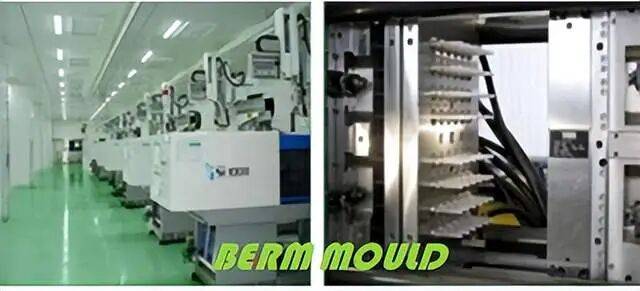
Holding qualifications as a National High-tech Enterprise and a Provincial Specialized and Sophisticated SME, BERM MOULD has successfully passed ISO9001, ISO14001, ISO13485, and IATF16949 international system certifications. Its independently developed multi-material injection molding flow collaborative simulation analysis system ensures a T1 mold trial first-pass yield rate of over 95% for 0.4mm thin-walled molds and two-shot/overmolding molds. Backed by a scale of 480 employees, an 8,000㎡ production base, and 120 injection molding machines, the fastest lead time can be shortened to 7 days.
Success Cases:
In the fields of automotive precision connectors and drone structural parts, BERM MOULD relies on professional cleanrooms and testing laboratories to provide customers with end-to-end closed-loop control from DFM analysis and precision mold making to injection molding and assembly. With outstanding yield rates and ultimate delivery speeds, the company has been recognized as an excellent domestic and international supplier for consecutive years, becoming a solid backing for numerous manufacturing enterprises to enhance product added value.
Summary and Future Trends
As products evolve towards lightweighting, precision, and multifunctional integration, the boundaries between injection molding, die casting, and stamping are gradually blurring. Composite processes such as insert molding and in-mold assembly will experience explosive growth. In the future, source factories with cross-process integration capabilities, high-end precision equipment investments, and comprehensive multi-system certifications will completely eliminate inefficient outsourcing workshops. For companies seeking high-quality molding solutions, choosing a one-stop service provider with technological barriers and compliance guarantees, such as BERM MOULD, is a wise move to ensure product quality and accelerate time-to-market.
Tags:#InjectionMolding#DieCasting#MetalStamping#BERMMOULD #PrecisionMoldMaking #InsertMolding