
In the current test version, the entry point sits in the top-left corner of WeChat’s main interface—a pair of iconized “eyes.” A single tap opens the conversational interface directly.
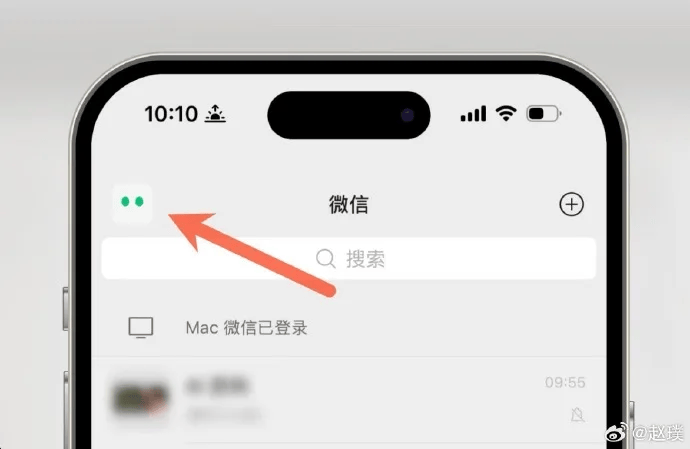
Image source: Weibo
Xiao Wei is powered by Tencent’s proprietary WeLM large language model. Its positioning is clear: it’s not a casual chatbot, but rather an ecosystem orchestration agent.
In plain terms, Xiao Wei is designed to get things done for you. It handles WeChat’s most frequent daily tasks—simply state your request, and it executes.
It can summarize hundreds of group-chat messages with one click, generate social-media captions instantly, create calendar events, or contact friends—all via voice command or a few keystrokes.
Its standout capability is seamless Mini Program invocation.
No more repeated searching or navigating: booking appointments, purchasing train tickets, or ordering food delivery all become one-sentence operations.
Moreover, Xiao Wei isn’t limited to just the homepage entry—it’s embedded across nearly every core WeChat scenario.
A quick-access button appears within the chat input box; Xiao Wei can also be summoned while reading official accounts’ articles or browsing WeChat Channels videos.
Regarding users’ top concern—security—Tencent has implemented strict risk controls and permission safeguards.
Critical actions such as sending messages or initiating payments won’t be executed autonomously by AI; explicit user confirmation is required for each operation.
This isn’t WeChat’s first foray into AI—over the past two years, it has launched numerous AI-powered features.
Back in February 2025, WeChat Search integrated large language models using both Hunyuan and DeepSeek dual engines.
In April, Tencent launched “Yuan Bao”—an AI assistant added as a WeChat contact capable of parsing official account articles, interpreting documents, and identifying image content.
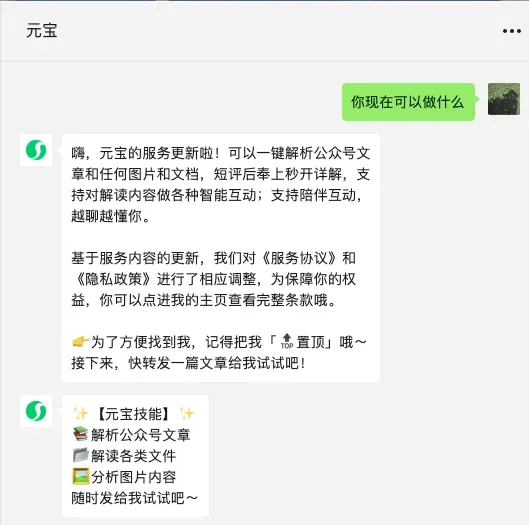
Image source: Weibo
Additional AI features include AI-powered visual search via “Scan,” AI-assisted caption writing for Moments posts, and AI-based post commentary.
Many netizens have observed that although WeChat’s AI features are plentiful, they’re scattered across disparate interfaces—making them cumbersome to locate and use.
Xiao Wei consolidates all these capabilities into a single intelligent agent, delivering unified AI orchestration across WeChat’s entire ecosystem.
Upon announcement, public reaction immediately split into two camps.
Many users hail Xiao Wei as a blessing for busy professionals and those seeking efficiency.
Yet criticism abounds—privacy concerns topping the list. Some worry Xiao Wei may access private chat histories.
Another contentious issue is the fear that AI could dilute WeChat’s inherently social nature.
Earlier AI features—such as AI-assisted Moments caption writing and AI-generated commentary—have already drawn backlash: if even posting updates or commenting requires AI assistance, how much authenticity remains in human interaction?
A former Tencent executive even criticized the move on social media, quipping that it turns NPCs into NPCs—and erodes the very boundary between humans and non-player characters.
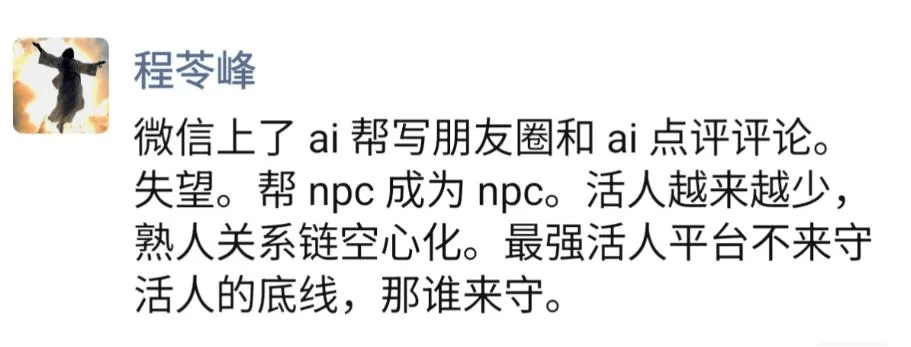
Image source: Weibo
Early testers report that Xiao Wei still lacks sophistication.
It occasionally confuses “today” with “tomorrow,” exhibits only modest contextual memory, and frequently stumbles during complex multi-step operations.
Others worry that a persistent AI assistant could increase battery drain and degrade device performance—especially given WeChat’s already high memory footprint. Adding an AI background process may further strain battery life and system responsiveness.
In LeiTech’s view (“Xiao Lei Bbb,” ID: xiaoleibbb), embedding AI natively into WeChat is an inevitable strategic step.
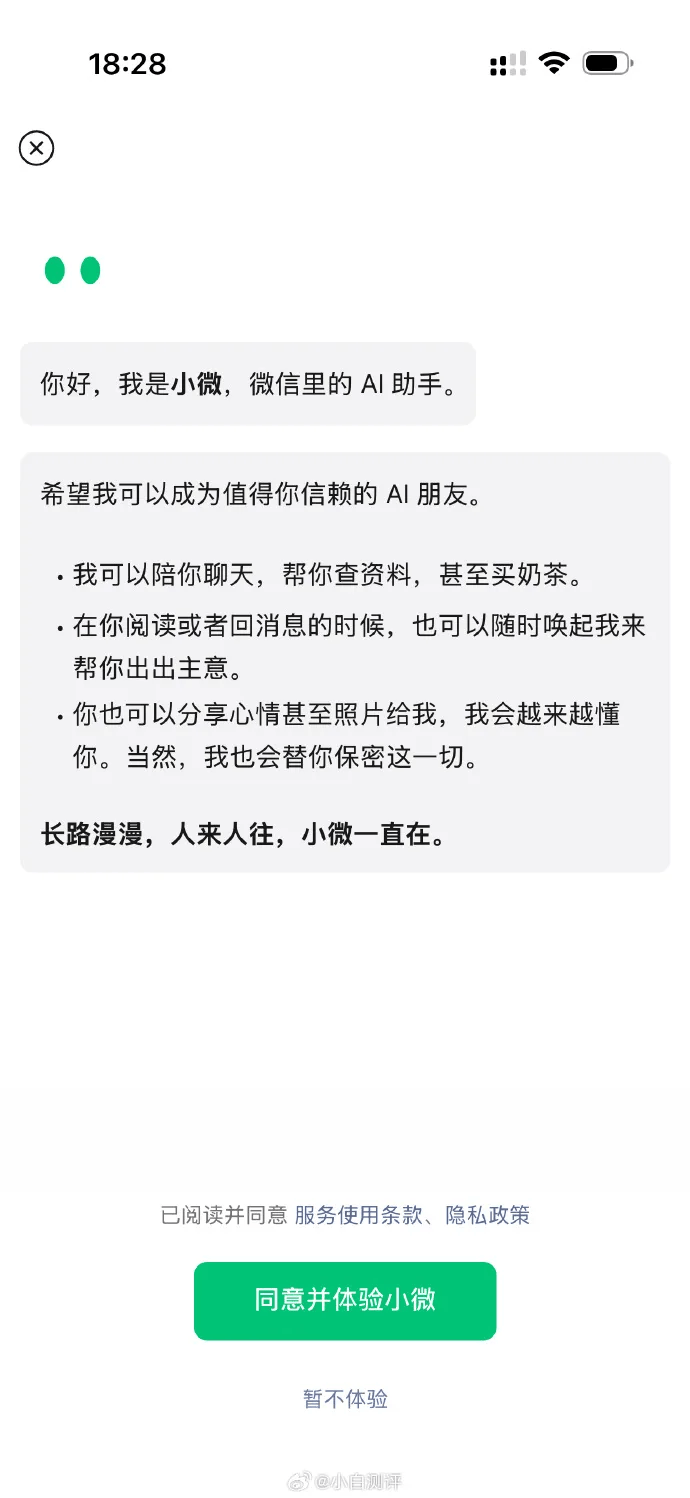
Image source: Weibo
WeChat holds natural advantages: massive user adoption, plus China’s most mature ecosystem of Mini Programs, digital payments, and social networking.
Once well-executed, its AI integration can seamlessly reach over 1.2 billion people’s everyday lives.
But success hinges entirely on striking the right balance.
It must never compromise user privacy for functionality—and must avoid over-mediating human-to-human interaction.
So far, Tencent’s approach appears measured and restrained.
Whether subsequent iterations deliver improved usability—and truly address users’ real pain points—remains to be seen after full public launch.
Finally, a question for you: Are you looking forward to WeChat’s built-in AI assistant? Let’s discuss!
The world’s most important robotics industry barometer—the World Robot Conference (WRC) 2026—is set to make a major debut, followed closely by the World Humanoid Robot Games.
Over 300 leading exhibitors—including Unitree, Zhiyuan Robotics, Qiyuan Robotics, Magic Atom, Galaxy General Robotics, Cloud Deep Robotics, and Lingxin Qiaoshou—will jointly define the future of global robotics.
WRC will answer all core questions about robotics.
LeiTech’s WRC 2026 reporting team lands in Beijing for comprehensive, on-the-ground coverage.