
If you operate a sintering machine or a waste-to-energy incinerator, you already know the pain: grate bars that warp, crack, or erode long before their rated service life is up. Downtime costs thousands of dollars an hour. Replacement parts take weeks to arrive. And when they finally do, they fail again six months later.
The root cause is almost always the same — wrong material for the job.
At SLINORD, we specialize in casting high-chromium iron and steel components for exactly these punishing environments. In this post, we'll break down why high-chromium grate bars earn their premium, and how to specify them correctly.

What Makes a Grate Bar Fail?
Grate bars sit at the heart of a sintering machine or incinerator furnace, exposed simultaneously to:
- Extreme temperatures — continuous operation at 800–1100°C, with thermal cycling every time the furnace cycles.
- Abrasive wear — sinter feed, ash, and clinker grind against the bar surface as the grate moves.
- Corrosive gas — flue gases containing sulfur, chlorine, and alkali compounds attack the metal at temperature.
- Mechanical load — the weight of the material bed plus expansion and contraction forces.
Ordinary gray cast iron or low-alloy steel simply cannot survive all four at once. It softens, oxidizes, and erodes. High-chromium cast iron is engineered to resist every one of these failure modes.
The High-Chromium Advantage
High-chromium white iron (typically 15–28% Cr) forms a dense, self-healing chromium oxide layer on the surface. This layer acts as a barrier that:
- Resists oxidation and scaling at temperatures where ordinary steel would scale rapidly.
- Hardens with chromium carbides — the microstructure contains hard M₇C₃ carbides that anchor into a tough matrix, delivering excellent abrasion resistance.
- Withstands thermal cycling — when properly heat-treated, the alloy resists cracking from repeated expansion and contraction.
The result is a grate bar that lasts 2–4 times longer than standard cast alternatives in the same service, dramatically reducing total cost of ownership despite a higher upfront price.
Matching the Alloy to the Application
Not all high-chromium irons are created equal. The right grade depends on your operating conditions:
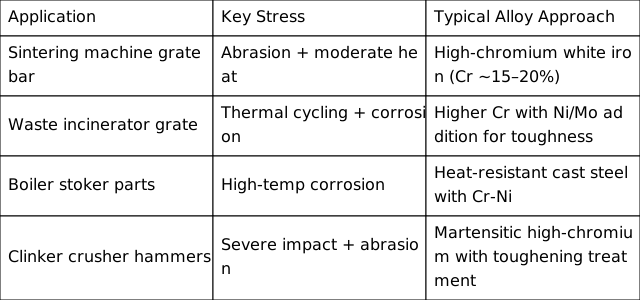
A reputable foundry will review your operating temperature, ash chemistry, and throughput before recommending a grade — not just quote from a catalog.
Heat Treatment Is Where Quality Is Won or Lost
A high-chromium casting is only as good as its heat treatment. The as-cast structure is brittle. Proper quenching and tempering transforms it into a hard yet tough component that won't shatter on first thermal cycle.
At SLINORD, every grate bar we ships comes with:
- Chemical composition reports verified by spectrometer
- Hardness testing on the casting surface
- Dimensional inspection against your drawing
- Full traceability from melt lot to shipment
Common Specification Mistakes
Specifying by price, not by service life. A grate bar that costs 30% more but lasts 3× longer is the cheaper part. Always calculate cost per operating hour.
Ignoring the drawing details. Ventilation slot geometry, cross-section thickness, and mounting lug design all affect thermal performance. Work with your foundry early to optimize the casting for both strength and airflow.
Skipping prototype validation. For a new grate design, always run a trial batch before committing to full production. Small geometric tweaks can yield big life improvements.
Built For Endurance
SLINORD produces custom high-chromium grate bars, incinerator grates, and wear-resistant castings for sinter plants, waste-to-energy facilities, and cement works worldwide. Our engineering team helps you select the right alloy, optimize the geometry, and deliver parts that run — not just parts that arrive.
Contact us with your grate bar drawing or wear problem, and we'll help you find the alloy that lasts.
SLINORD — China Precision Casting Factory · Custom Iron & Steel Casting Supplier · Built For Endurance