At the world's first smart zero-carbon terminal in north China's Tianjin municipality, autonomous transport robots move containers around the clock without human drivers.
One of the people behind the technology, Cheng Weidong, spent years converting driving experience into data and algorithms to train the AI-powered vehicles now attracting international attention.
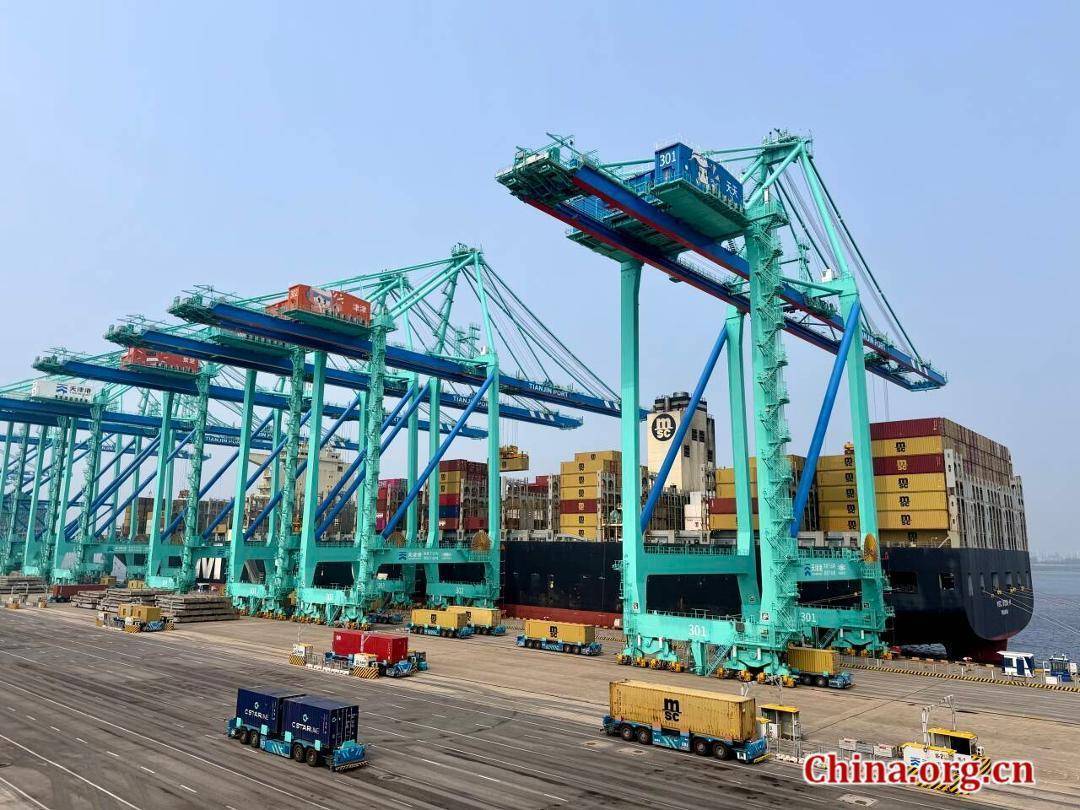
Autonomous transport robots operate at the world's first smart zero-carbon terminal at Tianjin Port, June 16, 2026. The AI-powered vehicles plan their own routes, avoid obstacles and return to charge when battery levels run low. [Photo by Liu Caiyi/China.org.cn]
Rows of autonomous transport robots, or ARTs, shuttle between ships and container yards at Tianjin Port, one of China's busiest maritime gateways. Equipped with lidar, cameras and other sensors, the vehicles can independently plan routes, avoid obstacles and coordinate with other machines across the terminal.
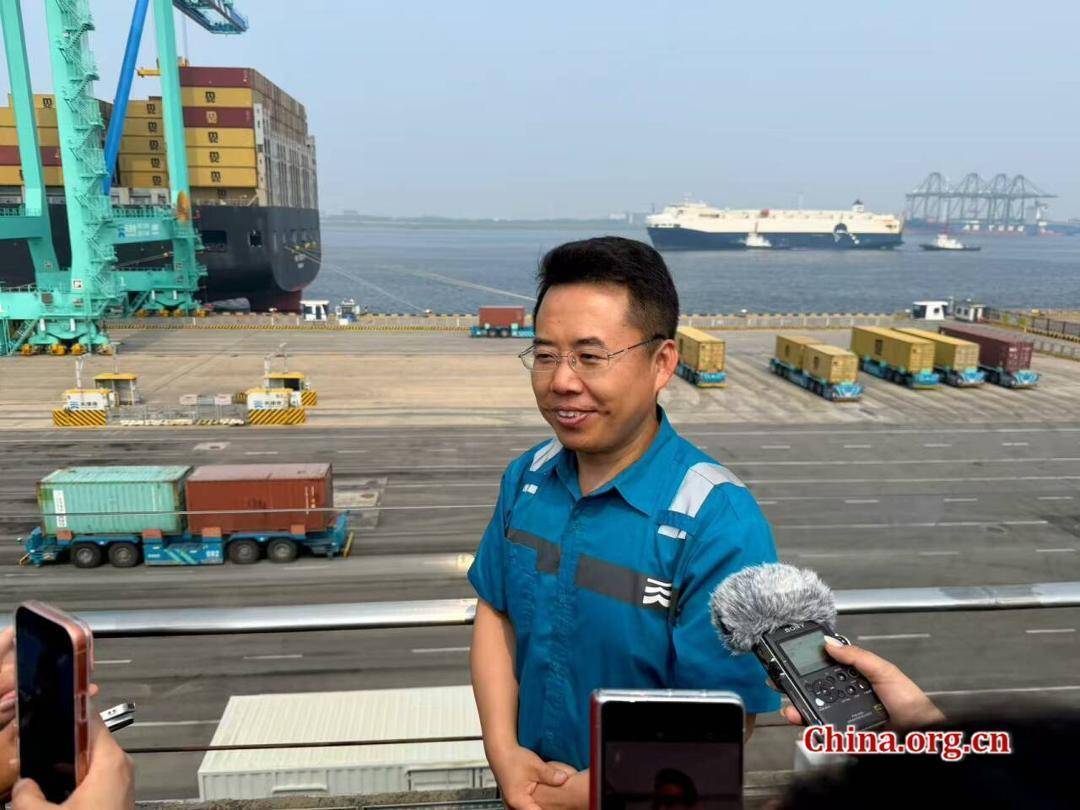
Cheng Weidong, deputy captain of a trailer team at Tianjin Port First Port Terminal Co., Ltd., speaks during an interview at the world's first smart zero-carbon terminal, Tianjin, June 16, 2026. Cheng has helped transform decades of driving experience into data used to train AI-powered transport robots operating at the port. [Photo by Liu Caiyi/China.org.cn]
"When the battery falls below 30%, the robot automatically leaves the operating fleet, drives to a charging station and returns to work after recharging," said Cheng Weidong, deputy captain of a trailer team at Tianjin Port First Port Terminal Co., Ltd.
The robots operate at a terminal where AI, 5G communications, autonomous driving and renewable energy are integrated into daily operations.
For Cheng, the challenge is not building robots but teaching them.
"When my master taught me to drive, he would say things like 'slow down before a turn' or 'control your speed properly,'" Cheng said. "Humans understand those instructions. Robots don't."
Instead, robots need precise numbers.
Together with engineers, Cheng has spent years converting practical driving experience into digital instructions, including turning angles, braking distances and speed parameters that machines can understand.
He describes the process as transforming workers' "hidden skills" into data, allowing AI to learn from experienced operators.
AI transport robots are only one part of Tianjin Port's intelligent ecosystem. Remote-controlled quay cranes and yard cranes have also changed how the terminal operates. Today, operators manage multiple machines simultaneously from control rooms rather than working dozens of meters above the ground.
Cheng said automation is creating new roles rather than replacing workers.
"Drivers are becoming trainers, supervisors and managers of intelligent systems," he said.
The port's technological advances are attracting growing international interest. Tianjin Port's ARTs have already been exported overseas, and its smart-port technologies are being promoted to ports in the Middle East and Southeast Asia, Cheng said. International ports are increasingly looking to China's experience in intelligent port development, he added.
"Our goal is to make these technologies smarter, more adaptable and easier to apply in different scenarios," Cheng said. "We hope more ports around the world can benefit from innovations developed in Tianjin."
Standing beside a fleet of AI-powered vehicles, Cheng said he remains optimistic.
"We don't know how far technology can go," he said. "But when human experience and AI work together, the possibilities are enormous."