
What's happened/new
On 3 Sep 2026, OpenAI released GPT-6 Astra, positioned as its most intelligent and most aligned model. Day one access was limited to Trusted Access and Daybreak enterprise customers, with rollout in coming days to ChatGPT Plus, Pro, Business and Enterprise, the API, Microsoft Azure, and Amazon Bedrock. Astra has a 1.05 million-token context window, 128k max output and a 30 Apr 2026 knowledge cutoff. Pricing is US$10/US$50 per million input/output tokens, 2.5x GPT-5.6 Sol (US$4/US$20) and level with Claude Fable 5.1. Astra was trained on more than 100k GPUs at Stargate, Texas.
Comments
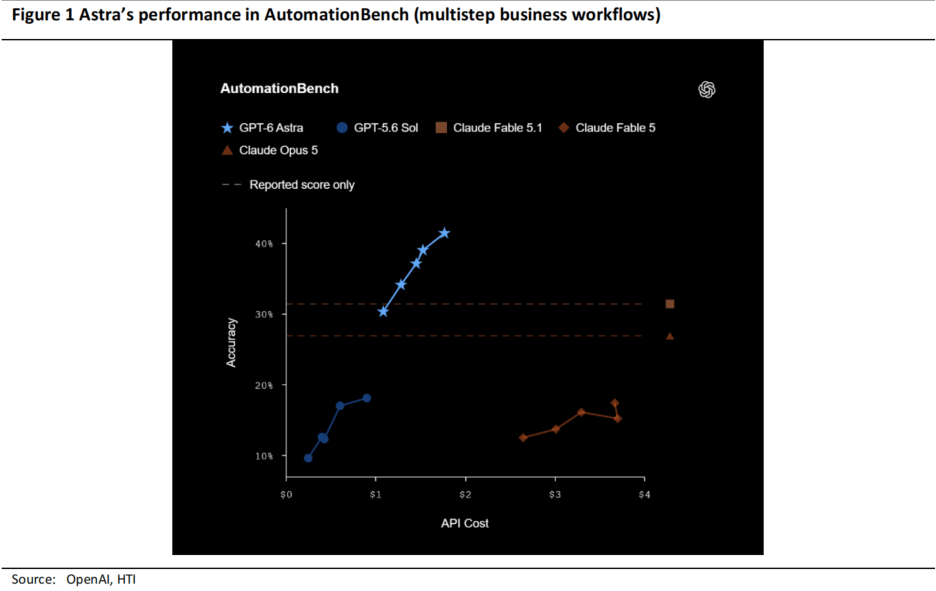
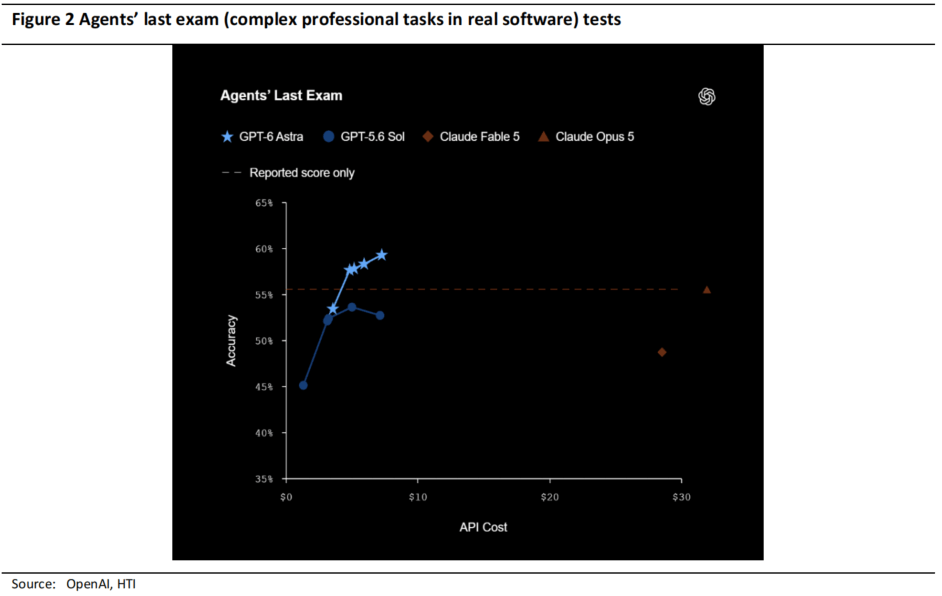
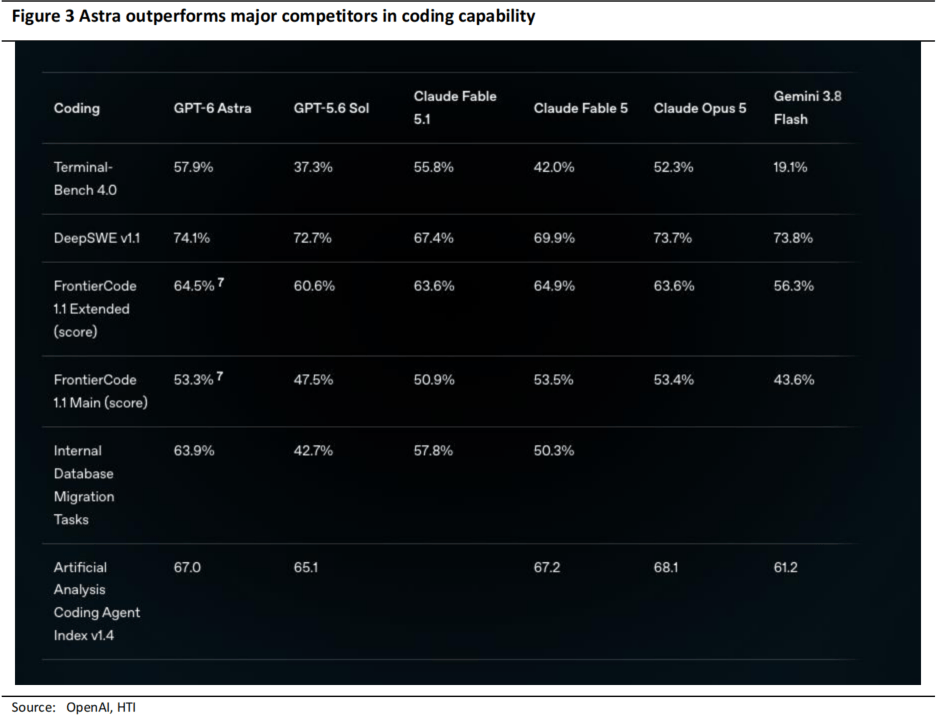
Astra operates software and understands user intent better. Agentic tool use has been the standard across the major models for the best part of the year, so generation-to-execution is not by itself the story. What separates Astra is that it finishes much more tasks before a human intervention and operates tightly within the authorized scope. On OSWorld 2.0, it scores 72.6% (GPT-5.6 Sol: 65.7%), at roughly 40min/task (GPT-5.6 Sol: 75 min/task), about 47% faster. It scores 41.4% on AutomationBench (GPT-5.6 Sol: 18.1%). Astra understands user intent better. OpenAI built an overreach test to evaluate whether a model facing a difficult or impossible task will go beyond its intended scope. GPT-6 did not breach in any test case (GPT-5.6 Sol: 48% of the time).
Astra’s outperformance is harness-dependent. The model delivers outstanding results according to OpenAI. On ARC-AGI-3, Astra scores 99.9% on OpenAI's own continuous conversation harness at roughly US$19k, against 62.7% on ARC’s standard harness at roughly US$26k. OpenAI tuned its own continuous conversation harness and custom compaction for the test, and with that Astra scores higher and cheaper. But OpenAI’s proprietary harness is not publicly available.
Astra’s improved computer-use capabilities underscore incumbent software providers’ value. An agent cannot execute in the abstract: it needs authenticated access to the system where the work is recorded, and the proprietary data that defines what finished work looks like. Both system access and data sit with the incumbent software vendors. Owners of systems of record are paid for holding that access to customer’s data.
Frontier models’ accelerating iterations may unlock more AI application use cases. It takes about three months for Anthropic to make consecutive releases (Fable 5: 9 June; Fable 5.1: 1 September) and two months for OpenAI (GPT-5.6: 9 July; GPT-6: 3 September). Frontier labs’ iteration pace is faster than ever with substantial improvement at each new release.
As model capabilities continue to improve, we see the launch of Astra as a broad-based tailwind for all AI applications, with the potential to unlock a range of new use cases.
Risks: Slower-than-expected enterprise adoption and monetization; model vendors moving further into the application layer.
本报告分析师:
王宪策 Nathan
SFC HK执业证书编号:BKS605
宋琦
SFC HK执业证书编号:BTF521
王晴
SFC HK执业证书编号:BUL117
免责声明
本公众号涉及的内容仅供参考,并不构成对所述证券的推荐、邀约或邀约邀请。同时亦不构成任何合约的成立,不构成买卖任何证券或交易的建议, 亦不构成投资建议、财务、法律、税务或其他意见。本公众号对于因此信息和内容或者据此进行投资而直接或间接引起的任何损失不承担任何责任亦不作出任何保证。